Illuminati Symbols: The Eye, the Pyramid, the Owl and Their Meaning
Which symbols the Bavarian Illuminati really used, where the all-seeing eye and pyramid come from, and what the triangle and owl mean, with sources.
The most famous “Illuminati symbols”, the all-seeing eye and the pyramid, have no documented use by the historical Illuminati. The best-documented emblem of the Bavarian order is the owl of Minerva, the Roman goddess of wisdom, shown perched on an open book. The eye and the pyramid come from Christian art and from the Great Seal of the United States, and were linked to the Illuminati only later, by legend.
This guide explains each symbol people associate with the Illuminati, separating what the historical record shows from what came afterwards.
Illuminati symbols at a glance
| Symbol | Used by the Bavarian Illuminati? | Where it actually comes from |
|---|---|---|
| Owl of Minerva on a book | Yes, documented in a printed account of the order’s system, around 1788 | Classical symbol of wisdom; Minerva gave her name to the order’s Minerval grade |
| All-seeing eye (Eye of Providence) | No documented use | Christian art, where it stands for God’s watchful care; the reverse of the U.S. Great Seal (1782) |
| Pyramid with an eye | No documented use | The reverse of the U.S. Great Seal, designed by order of the Continental Congress |
| Triangle | No documented use as an order emblem | Christian symbol of the Trinity; modern hand gestures |
| “1776” / MDCCLXXVI | Coincidence of dates | The year of American independence, at the base of the Great Seal’s pyramid |
The owl of Minerva: the real Illuminati symbol
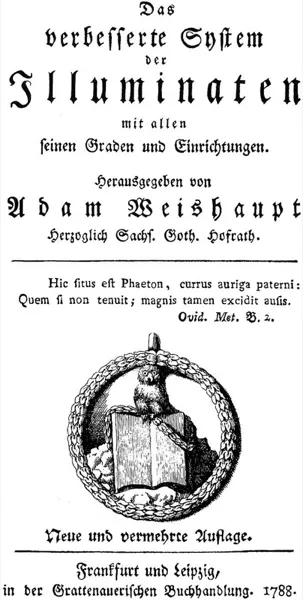
The Minerval emblem: an owl standing on an open book. From Das verbesserte System der Illuminaten (“The Improved System of the Illuminati”), around 1788; artist unknown. Public domain, via Wikimedia Commons.
The Bavarian Illuminati, founded by the Ingolstadt law professor Adam Weishaupt in 1776, chose an emblem that matched its purpose. Its early members were “Minervals”, a grade named after Minerva, the Roman goddess of wisdom. An owl, Minerva’s traditional bird, perched on an open book is the emblem associated with that grade.
The design says a great deal about what the order valued. The owl stands for wisdom; the open book beneath it stands for learning. According to National Geographic, a novice who wished to advance had to report on the books he owned and on the weak points of his own character. Education stood at the center of the order’s design.
The owl of Minerva has a long history of its own. In classical tradition it accompanied Athena, Minerva’s Greek counterpart, and it has remained a symbol of wisdom and reflection ever since.
The all-seeing eye (Eye of Providence)
What it means. The eye surrounded by rays or set inside a triangle is called the Eye of Providence. “Providence” means God’s care for the world. In Christian art the eye represents God, and the triangle around it stands for the Trinity.
The Uffizi Gallery in Florence holds a striking example. In Pontormo’s Supper at Emmaus (1525), the museum explains, “the divine eye at the top, a symbol of God the Father within the trinity triangle”, is the result of a repainting after the artist’s death, made to cover an earlier three-faced image of the Trinity that the Counter-Reformation had prohibited.
How it reached the dollar bill. In 1782 the heraldry student William Barton, assisting the third committee appointed to design the Great Seal of the United States, proposed a reverse side showing “a 13-step unfinished pyramid topped with the Eye of Providence”, according to the National Archives. The Latin motto above the eye, Annuit Coeptis, means “He [God] has favored our undertakings”. Congress approved the final design of the seal, submitted by Charles Thomson, on 20 June 1782.
Was it an Illuminati symbol? No source documents the Bavarian order using the eye as its emblem, and no documented link exists between the seal’s designers and the order. The Great Seal was designed by committees of the Continental Congress, while the Illuminati were a society based in Bavaria. Our misconceptions guide looks at this claim in detail.
The Illuminati pyramid
The pyramid most people picture is the one on the back of the U.S. one-dollar bill. It is the reverse of the Great Seal, and the National Archives describes its elements this way:
- The pyramid of thirteen steps represents strength.
- MDCCLXXVI at its base is 1776 in Roman numerals: the year of the Declaration of Independence.
- Novus Ordo Seclorum on the scroll beneath means “A New Order of the Ages”, marking the beginning of a new era for the United States.
Two details explain much of the confusion. The year 1776 is also the year the Illuminati were founded, a coincidence with no documented connection. And Novus Ordo Seclorum is sometimes read as “New World Order”. The National Archives translates it as “A New Order of the Ages”: a new era, not a world government.
The pyramid reached everyday wallets in 1935. According to the U.S. Currency Education Program, the new one-dollar design approved by President Franklin D. Roosevelt that year placed both sides of the Great Seal on the note, with the pyramid on the left.
The triangle and “Illuminati hand signs”
In Christian art the triangle stands for the Trinity, which is why the Eye of Providence is so often drawn inside one.
In recent decades, hand gestures in the shape of a triangle or diamond, made by musicians and celebrities, have been described online as “Illuminati signs”. No evidence links them to the historical order. Our misconceptions guide examines celebrity “membership” claims and why they do not hold up.
Why these symbols became “Illuminati symbols”
The Illuminati were banned in Bavaria in the 1780s. Their legend began in 1797–98, when books by Augustin Barruel and John Robison argued that Freemasons and the Illuminati had secretly prepared the French Revolution, as our Illuminati history timeline explains. Over the following two centuries, the name became attached to almost anything that looked mysterious, and symbols that were well known for other reasons were drawn into the story.
The pattern is easy to see:
- A familiar symbol, such as the eye or the pyramid, has a documented origin elsewhere.
- A coincidence, such as the year 1776, suggests a hidden connection.
- The connection is repeated until it seems established, even though no historical document supports it.
How to judge any “Illuminati symbol” claim
Three questions help:
- Who used it first, and when? Most symbols are far older than the claim attached to them.
- Is there a document? Much of what historians know comes from the order’s own papers, seized by the Bavarian authorities. A symbol that appears nowhere in them deserves caution.
- When did the association appear? If the link to the Illuminati was first made long after the order was banned, it tells us about the legend, not about the order.
Asking these questions is what independent thinking looks like in practice. Our article on the power of independent thinking explores the habit further.
Frequently asked questions
What is the main Illuminati symbol?
The best-documented emblem of the historical Bavarian Illuminati is the owl of Minerva perched on an open book, associated with its Minerval grade. The all-seeing eye and the pyramid are later associations.
Is the eye on the dollar bill an Illuminati symbol?
No. It is the Eye of Providence on the reverse of the Great Seal of the United States, part of the seal’s reverse adopted in 1782 and placed on the one-dollar bill in 1935. There is no documented link to the Bavarian order.
What does the Illuminati eye mean?
The eye itself, the Eye of Providence, means divine watchfulness: God’s care for humanity. Its “Illuminati” meaning of hidden surveillance comes from modern legend, not from the historical order.
What does the Illuminati pyramid mean?
The pyramid on the dollar bill is the Great Seal’s unfinished pyramid of thirteen steps. According to the National Archives it represents strength, and the date at its base, 1776, marks American independence.
What does the Illuminati triangle symbol mean?
In Christian art the triangle represents the Trinity, often with the Eye of Providence inside it. No document shows the Bavarian Illuminati using a triangle as their emblem; the “Illuminati triangle” is a modern association.
Who are the Illuminati, historically?
A secret society of the Enlightenment, founded in Bavaria in 1776 and banned in the 1780s. See Illuminati members for the people who belonged.
What remains uncertain
- When the owl was adopted. The emblem shown here comes from a printed source of around 1788. Some historians date the owl to the order’s founding in 1776; we have not been able to check that claim against the original documents.
- The full range of the order’s imagery. The order used several grades, rituals and ciphers, and not all of its papers survive. Other emblems may yet be documented by specialists.
Illuminati Voice is a present-day community of independent thinkers. We write about this history as an educational subject and do not claim any organizational connection to the Bavarian Illuminati. About us · How to join.
Sources
- Minerval insignia, from Das verbesserte System der Illuminaten (c. 1788), public domain — Wikimedia Commons
- Meet the Man Who Started the Illuminati — National Geographic
- The Great Seal of the United States — U.S. National Archives
- The Great Seal: Celebrating 233 Years of a National Emblem — U.S. National Archives, Prologue blog
- Noteworthy podcast: Symbols of the Seal — U.S. Currency Education Program
- Supper at Emmaus by Pontormo — Gallerie degli Uffizi
